On the surface, understanding your bike gears is pretty simple. You push the lever one way to make it easier to pedal, and the other to go faster. choosing the right gears to install on your bike however, can be much trickier.
Most of us just end up riding the gears that came with our bikes, but if you don’t think about swapping out for different scenarios, you might end up making things much more difficult than they need to be.
The gear ratios you want to use for a hilly cycling holiday in Mallorca are not the same as the gears you want for a time trial, criterium, club ride or city riding. Our complete guide to bike gears takes the mystery out, and will have you joining in with all the other bores banging on about ratios in no time at all.
Front Gears (Chainrings/Crankset)
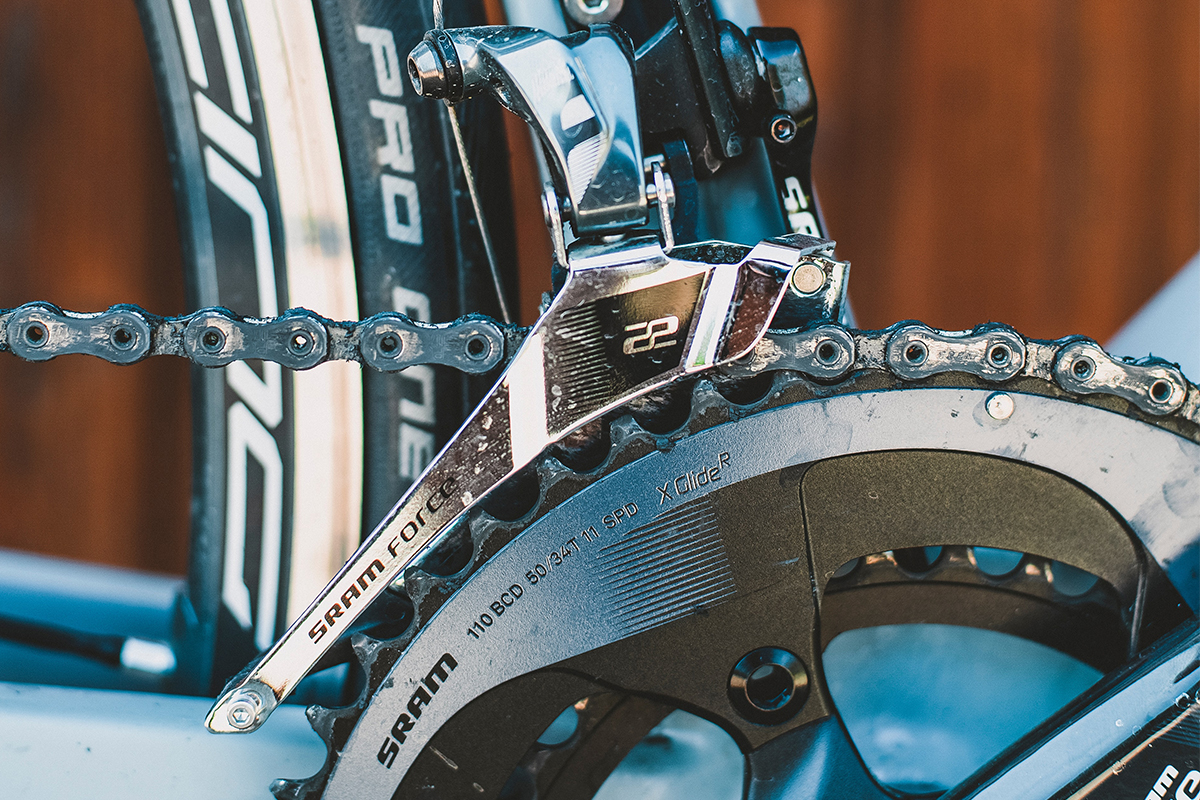
The front gears are referred to as chainrings, or as a crankset, or by the less jargon-savvy cyclists, ‘the front ones’. Actually, the whole assembly with the crank arms and the front gears together is properly known as the ‘crankset’, or sometimes ‘chainset’. Most cranksets have either two (called a double or 2x), or three (called a triple or 3x) chainrings. Single (or 1x) chainrings are gaining popularity, particularly among mountain bikers and cyclocross riders, but are still a fairly niche application. On the crankset, the smallest chainring is closest to the frame. The smaller the chainring, the easier the pedalling. As we move the chain away from the centre line of the bike, the pedalling gets harder but you go faster. Typically the chainrings are identified by mentioning their position (“inner”, “outer”, or, in the case of a triple “middle”), or by their size “big ring”, “little ring”. On a triple they’re usually called “outer/big”, “middle” and the smallest one has a special name – “granny gear” or just “granny”.

Rear Gears (Cassette)
The gears on the rear wheel are called ‘cogs’ and when you put a few of them together in ascending size and attach them onto your back wheel, they are referred to as a ‘cassette’. Most bikes built in the last few years have between 8 and 11 cogs in the cassette. The largest cogs are closest to the wheel and the gears are numbered from the inside out. The larger the cog the ‘lower’ the gear and the easier it will be to pedal, but the slower you will go.
How Many Gears?
When we talk about how many “speeds” a bike has, there can be some confusion. The marketing department likes to multiply the number of cogs by the number of chainrings because big numbers are impressive. But the fact is there’s actually a lot of overlap, so a 9×2 doesn’t really have 18 gears. People who actually ride bikes only refer to the number of cogs in the cassette, so an 8 speed, a 9 speed etc… They may also mention whether they have a single, double, triple crankset, or they may simply say “9×2” or “2×9”.
Derailleurs
‘Derailleur’ is pretty hard to pronounce, but – fortunately – pretty easy to understand. The chain gets moved from one cog to another or one chainring to another by means of a derailleur. The front derailleur is a fairly simple device that simply pushes the chain off of one chainring to be picked up or ‘caught’ by the next.
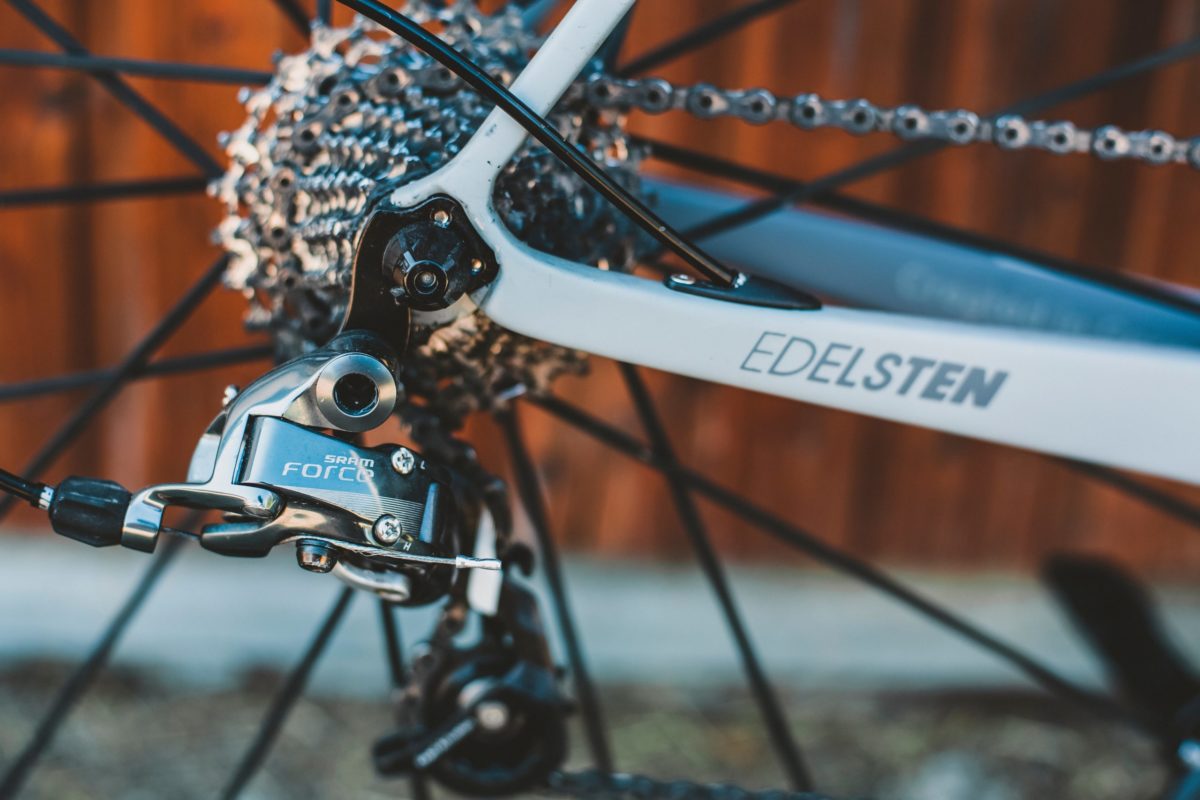
The rear derailleur is a little more complex as it has two jobs. Like the front, it guides the chain from one cog to the next, but it is also responsible for maintaining chain tension and taking up the slack when we move from bigger gears to smaller ones. The rear derailleur has two little gears (actually called ‘pulleys’) in it, and the chain makes an ‘S’ turn through them. The upper pulley (closest to the cassette) is referred to as the ‘jockey pulley’ and the lower pulley is called the ‘idler pulley’. The pulleys are held in position by the ‘cage’.
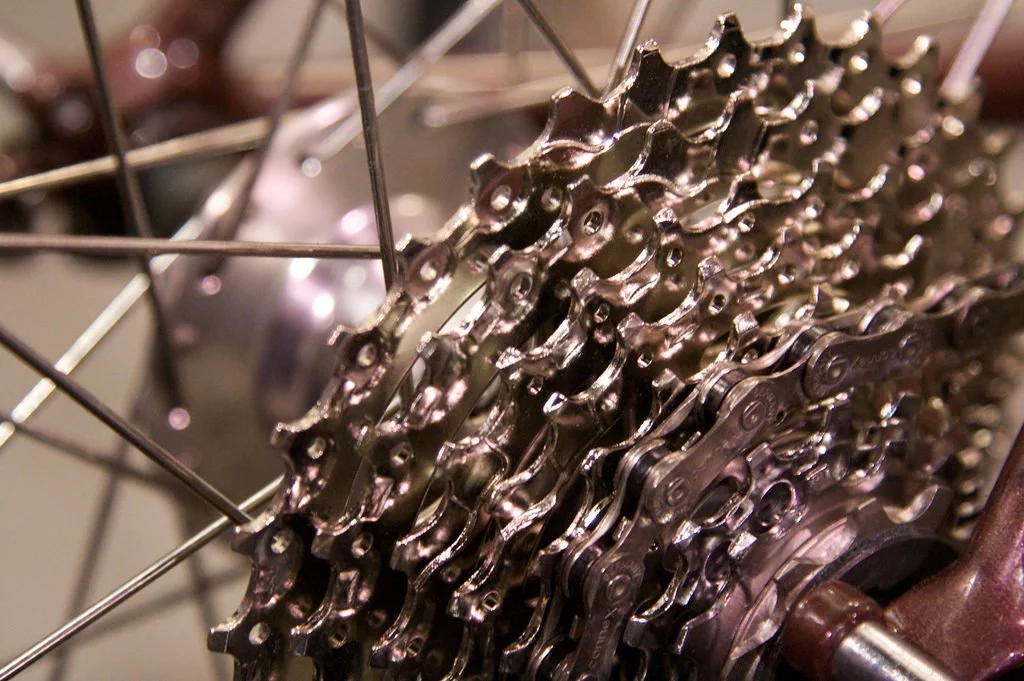
You’ll find it’s much more difficult to shift your front gears while the chain is pulled really tight, so you should lighten your stroke a bit when switching chainrings. The rear derailleur is much more effective at switching gears while pedalling hard. It is important to note however, that in order to switch gears the chain must be moving forward.
With both the front and the rear derailleur, when the shift cable is pulled, it will move the chain to a larger gear. When the cable is released, it will move the chain to a smaller gear. Just remember that larger gears at the rear mean easier pedalling but more torque, and larger gears at the front mean harder pedalling but more speed. Going from “easier” gears to “harder” gears is called “upshifting”, and the reverse is called “downshifting”.
Teeth & Bike Gear Ratios Explained
11 cogs on the rear cassette and two on the front chainring essentially gives you 22 different options (though some of these may cross over so not strictly true).
The key element that will determine how hard you work is the difference in the number of teeth (the wee pointy bits that hook through the gaps in your chain) between the front chainring at the front and your selected rear cog.
Let’s take my bike as an example:
The chainring (front) on my bike is 50/34T. That means the outer ring has 50 teeth and the inner ring has 34 teeth.
The rear cassette is 11 speed 11-32. This means there are 11 cogs ranging from 11 teeth up to 32 teeth (the exact cogs are 11/12/13/14/16/18/20/22/25/28/32).

The combination of your selected chainring and cog determine the gear ratio. The gear ratio, combined with the circumference of your wheel and tyre determines how far you will travel with each revolution of the cranks.
The Hardest Gear
Let’s say I am in the hardest gear on each which means I would be riding on the 50 tooth ring on the front, and the 11 tooth ring on the back. To get our gear ratio we divide the number of teeth on the front by the number on the back:
50 ÷ 11 = 4.55
This is expressed as 4.55 : 1 meaning that for every 1 turn I make of the pedals at the front, I will turn the back wheel 4.55 times. This is the gear I would use on the flat. It is going to take quite a lot of effort to get it moving, but when I do I will move quickly.
The Easiest Gear
This would be the opposite end, the small ring on the front and the biggest on the back. The reason for this is that they are the closest together, meaning you get a really low ratio. On the bike I ride this is 34 teeth at the front and 32 at the back – so really close.
34 ÷ 32 = 1.06
1.06 : 1 means I am only just moving the back wheel through more than one revolution for every turn of the crankset. This would be the gear I am using on the very toughest of climbs allowing mean to spin the wheels quickly to get my cadence high.
Different Gearing Set-Ups
Crank Set (Front Gears)
You may sometimes hear cranksets referred to as ‘compact’ or ‘standard’. A compact crankset typically has a 50 tooth (50T) big ring and a 34 tooth (34T) little-ring. Standard cranksets are typically 53T/39T. In most cases, you can change your chainrings to have different tooth counts, but as a general rule you don’t want to have more than a 16-tooth difference between the big ring and little ring or you may have shifting issues. As for triples, they tend to run even smaller gears and more closely spaced 26T/36T/46T and 52T/42T/32T are common triple crankset configurations. With 10 and 11 speed drivetrains becoming the norm, we’re seeing triples fall out of fashion and even single ring cranksets are becoming popular because of the wide range of ratios an 11-speed cassette can span.
Cassette (Rear Gears)
As mentioned earlier, today’s bikes typically come with 8 to 11 cogs in a cassette. When choosing cassettes, you can choose a cassette that has a narrow range of ratios but closely spaced between each cog, or you could choose a cassette that offers a wide range of ratios but at the cost of bigger jumps between cogs. Choosing a bike that has more speeds reduces the tradeoff some, and gives you more versatility. If you do most of your riding in a place that is generally flat, it’s probably best to opt for a narrow-range cassette with small ratio jumps as that allows you to really fine-tune your cadence and effort level. If you live in an area that has more varied terrain, a wider-ranged cassette may be the better choice to help you get up those hills. Wider-ranged cassettes with higher cog counts typically have the ratios more closely spaced on the smaller cogs, and then have the bigger jumps in the bigger “climbing” cogs to give you a little of the best of both worlds.
What Can We Learn From This?
The key learning from all this information is to make a conscious choice when you purchase a bike as to the gear range that you want.
If you are climbing, then the natural choice is going to be a compact crankset, or in extreme cases a triple, but think about the rear cassette. My first bike had an 11-28, but I really like keeping a high cadence on the hills, so on my new bike I have opted for 11-32. This means I still have a nice fast high gear, but the lowest gear is significantly easier to pedal. If you are a keen time trial rider then you may want to opt for a standard crankset, as it will give you a higher top gear. This paired with something like an 11-23 rear cassette would be great for flat course as it would give you very small changes between the gears meaning you could keep the cadence exactly where you wanted it.
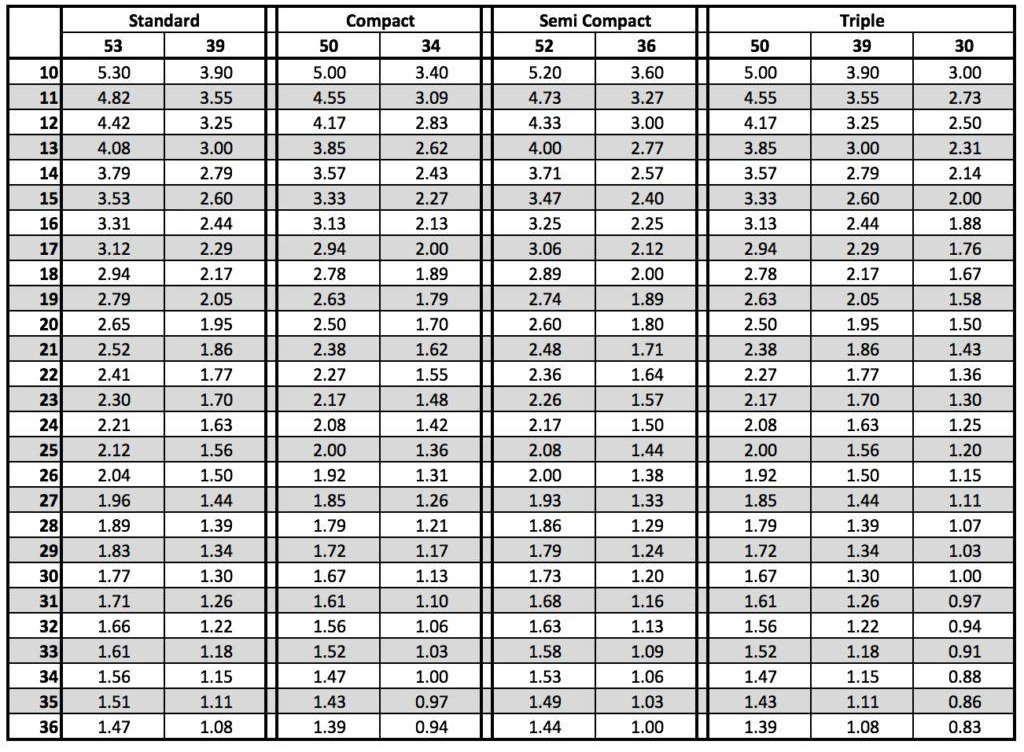
The key is to know the kind of riding you are planning to do with the bike you purchase and choose the gearing accordingly. I have produced the chart below to help you understand the typical ratios available. Remember the higher the ratio, the harder/quicker the gear is going to be.
How Do We Use Gears?
So now you’ve had a quick intro to how your gears work together, here are three final tips to take with you on your next ride.
- Avoid ‘cross-chaining’: Cross-chaining is when you have a little/little or big/big combination. This puts stress on the drivetrain and can cause premature wear of the components. It’s OK if you occasionally find yourself cross-chained – say for a short, steep climb – but it is something you’ll generally want to avoid. The rule of thumb to follow is that when on the big ring, only use the smaller two-thirds of the cassette. When on the inner (or middle) ring, only use the inner two-thirds. When in ‘granny gear’ limit yourself to the largest two or three cogs.
- Anticipate your shifts: Keep an eye on the road ahead and shift before you have to. You’ll maintain a smoother power output, and you’ll be shifting at a time when there’s less stress on the drivetrain – so your shifts will be smoother too. As you approach a red light or stop sign you should also downshift a couple of gears, in anticipation of getting rolling again as smoothly as possible.
- Keep pedalling!: It is much more efficient to keep a constant, steady power rather than ‘burst and coast’ riding. It sure feels like you’re getting better exercise when you make that big effort, but you’re putting all the load on your muscular system, which isn’t really good at sustained effort. Spinning light and fast ends up putting out the same amount of power, but shifts the load to your cardio-vascular system, which is good at endurance activity.
Additional Reading and Useful Links
CyclingTips.com – Understanding Gear Ratios and Why They Matter
Yellow Jersey offer bicycle insurance to protect your equipment and travel insurance to cover medical mishaps while cycling overseas.